Sunday, October 28, 2012

"Reach for the Sky!"


Stephen Colbert had actor Tom Hanks on his show the other day. The skit features trick-or-treaters showing off the diversity of heroic characters the actor has portrayed (while plugging Cloud Atlas where Hanks plays multiple characters). It was a fantastic example of New American Mythology on several levels. First, both the real person and the characters have become icons of American culture. Everyone recognizes the names Tom Hanks, Woody, and Forrest Gump and views them as separate icons. This is different than  Will Ferrell characters for example. People recognize Ferrell as an iconic actor, but he is not separate from his characters- instead its Ferrell as racecar driver, Ferrell as man-child, Ferrell as a news anchor. (There are exceptions of course, such as Buddy the Elf.) For Hanks, both being an icon and portraying/creating icons means he has a strong presence in New American Mythology in both the past an present.

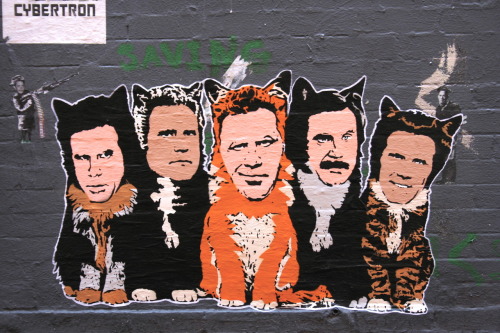
An artwork by street artist Tom Hanksy
(as in Tom Hanks + Banksy)


Because of his pantheon of characters, Hanks' mythic presence reaches all types of people regardless of the genre preference, age, gender, and race. He appeals to everyone, allowing him to explore, perpetuate, or change New American Mythology with broader strokes than a single movie, show, or character could do on its own. People pay attention to what he does.

Which leads to the second point: Hank has the ability to influence New American Mythology's direction in the future. Hank has taken advantage of this through his recent roles which tend to convey a wholesome, positive message or somehow educate the audience. That is not to say his character in Philadelphia (Tristar Pictures, 1993) for example didn't do that. Rather, Hanks now seems to consciously create/seek roles that enlightens audience with morals or history. Specifically: Charlie Wilson's War (Universal, 2007), The Pacific* (Dreamworks SKG, HBO Films, 2010) as narrator and producer, Extremely Loud Incredibly Close* (Paramount Pictures, 2011), and Cloud Atlas* (Cloud Atlas Production Company,  2012). Of course, to fund such projects (and keep his status as mythic icons) Hanks still acts in movies like The Polar Express* (Castle Rock Entertainment, 2004) and Angels and Demons* (Columbia Pictures, 2009).

I found Polar Express to be on the edge of the uncanny valley.
Not that either category is more influential or better than the other. Take The Da Vinci Code (Columbia Pictures, 2006); A lone man (Robert Langdon) must solve a mystery to prove himself innocent, and in that process discovers the Vatican's secret. *Spoiler* The secret is that Jesus and Mary Magdalene had a daughter who would have been the 'true heir' of Christianity. Of course the patriarchal system of the Vatican found this terrible and stopped it. The movie critiques Catholicism, patriarchy, and authority as a whole while questioning the purpose of iconography that perpetuates certain ideals (i.e.Why do we revere da Vinci's deteriorating painting, Last Supper?). Larry Crowne (Universal Pictures, 2011) on the other hand is a more encouraging movie, where instead of falling into depression after losing everything, the main character seizes the day and goes back to college. A very feel good, happy movie that advises people to turn negatives into positives, but it's really not a reality shattering message.

So what does this all really mean? Tom Hanks' work reveals New American Mythology as spanning the past, present, and future on multiple fronts, influencing how Americans see and react to the world around them. The following character analysis shows that Hanks chooses roles that emphasize that all individuals can succeed, no matter what skills they have.


An Astronaut, Cowboy, and Zombie:

Forrest Gump (Paramount Pictures, 1994) - Forrest is a Zombie in the best way possible. He lacks rationality, is unthinking, acts out of compulsion, and has no real need for purpose in life. All these things of course make him a great football player, soldier, ping-pong player, and runner. His selfless nature often puts him in dangerous and inadvisable situations while his impassive personality allows him to not be governed by traditional wants and desires (i.e. money, fame, sexual conquest, etc). He is a Zombie. No arguing.

Apollo 13 (Universal Pictures, 1995) - Jim Lovell is a real figure in American History. Tom Hanks/This movie turned him into a real figure in American Mythology. Lovell is the most Astronaut of astronauts to ever grace the silver screen. He is rational, empathetic, and calm throughout the movie, despite his dangerous situation. And, of course, he placed himself in a situation (going to the moon) that he knew could go very wrong, just to better American's knowlegdge/image.

Toy Story (Pixar Animation Studios, 1995) - Woody is a not a Cowboy, but an Astronaut. He is rational, looks out for others, and willing to risk his happiness for others. The closest Woody comes to becoming a Cowboy is worrying about his position as leader of the toys when Buzz comes around. So when the doll says "Reach for the Sky!," he's not enforcing western law, but telling you to set your aims higher.

[Tom Hanks doesn't really play Cowboy characters, with perhaps the exceptions of Jimmy Dugan in A League of Their Own (Columbia Pictures Corporation, 1992), Joe Fox in You've Got Mail (Warner Bros., 1998), and Michael Sullivan in Road to Perdition* (Dreamworks SKG, 2002). This trend continues in the 21st century, unless you want to count...]


Cast Away (Twentieth Century Fox Film Corp, 2000) - Chuck Noland whose journey transforms him from a Zombie to a Cowboy and/or Astronaut. He begins as a Zombie- focusing on his job to get money, despairing at his situation, and hoping someone else saves him. Eventually he learns that he must fend for himself, fight to live, like a proper Cowboy in a purgatory West. However, one could also argue that he is an Astronaut, living in isolation and relying only on himself to survive trying to find the truth of himself in purgatory West. Even the movie's end could be argued either way- is he a Cowboy living on his instincts, going wherever the wind blows him, or is he an Astronaut journeying into the great unknown, searching for the mysterious Truth.
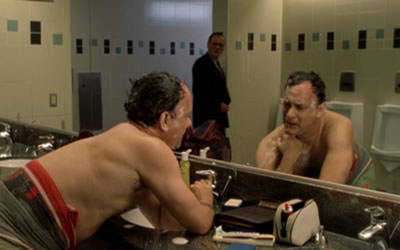
Shenanigans in The Terminal
The Terminal (Dreamworks SKG, 2004) - Viktor Navorski is a Brown. I wanted to include this movie, despite its relatively bad reviews to show that Hanks does not always stick to the main archetypes. Navorski not an isolated Astronaut who uses rationality to fight his situation. He is not a Cowboy who would have just busted out of there. He might be a bit of Zombie who only follows the rules, but he is a bit too compassionate, helpful, and resourceful to really fit in that archetype. Navorski, an Eastern European, has no power (politically, sexually, and seemingly socially). However, he still turns his situation into a positive experience helping his fellow man [maybe he is an Astronaut].

I could do this all day with Hank's films. I could go in depth to every one of them (especially the Toy Story franchise), but there are so many it might get boring for you.  However, feel free to leave your own observations, questions, and comments below. 

With that I'll leave you with an Astronaut Tom Hanks quote:

"I love what I do for a living, it's the greatest job in the world, but you have to survive an awful lot of attention that you don't truly deserve and you have to live up to your professional responsibilities and I'm always trying to balance that with what is really important."

----------------------------------------------------


*I have not seen these movie, so my analysis may not be correct

Monday, October 15, 2012

Zombie Season Begins!

Walking Dead (AMC, 2010) started up tonight, signaling the start of Zombie season. I don't mean the time that the television show airs- I mean the time of year that consumerism takes over the minds and motivations of Americans.

PBS video to celebrate the Season 

Like pre-industrial cultures, autumn is a time for celebration, preparation, and consumption. Traditionally, the event is to prepare for the hard-long winter and/or to harvest the crops. Luckily,  the majority of Americans American's do not have to worry so much about food security and instead just get to celebrate abundance. That's not to say that other times of year are void of conspicuous consumption or unnecessary excess. After all, do you really need 2 packs of hotdogs, a pound of burgers, and ribs at the family Fourth of July barbecue?  Zombie season is just where it's a little more obvious and often and without the connotations of rebirth (Easter/Spring, Forth of July/Summer). And it comes with the premiere with Walking Dead.

Autumn settles in during October; the cold weather sets in and the leaves begin to fall. Associations with death are well known.  However, American's don't worship Osiris or Persephone. They worship the Zombie archetype (God of Consumerism). During Halloween, the Zombie manifests itself by encouraging people to dress up as their favorite characters and buy copious amounts of overpriced candy. Unlike Dia de los Muertos, Halloween does not hold any sort of religious connotations nor gathering of family (unless you want to count children going to trick or treating as gathering as family. I don't.) The holiday celebrates popular culture; all ages can become Astronauts, Cowboys, Zombies, Blacks, Browns, and Girls without looking like a total nerd (unless that's what you're going for).

Found on the internet

That's just the beginning however. Thanksgiving comes up about four weeks later. Again, the holiday does not have religious connotations, but it does focus on family, patriotism, and tradition. The literal consumption of food and gathering of family hearkens to the Harvest Festivals of old. Even though Thanksgiving retains the integrity of such festivals and isn't as Zombie-ridden as Halloween (or the next holiday), it still contains giant floating pop culture icons and football, which I've already described as Zombie driven.

Then, the big one. Christmas begins before Thanksgiving. We've all heard the complaints/celebrations on the advanced arrival of the 'holidays'- and that's just the decorations and  music. On Black Friday (an event that has it's own name) people bull rush stores to collect bits and bobs to give to children, adults, dogs, cats, and everything in between. All sorts of confectioneries and limited edition drinks pop into existence as temptations. Christmas morning (for most people) creates a mess of wrapping paper and boxes. Food usually makes an appearance in amounts comparable to Thanksgiving, but with more sweets. Christmas does have religious aspects connected to it, but these are overshadowed by the Zombie celebrations.

Still not as scary as Krampus
Found

It doesn't end there however, New Years brings similar Zombie consumption, except with friends rather than family. When else do over 3.5 million viewers tune in late at night to watch a bunch of commercials  listen to mediocre music, and watch a ball drop? Answer: The Superbowl.

Finally the last Zombie holiday, Valentine's Day. It straddles Winter and Spring- both pressuring people to, again, eat more candy, and force themselves into uncomfortable situations for the sake of  social pressures. Again, the holiday has no religious connotations.

The most ironic holiday

That's five months and six holidays, only one that still follows the religious practices that initiated it, (you could, arguably, call the Superbowl a religious holiday) while Thanksgiving remains closest to its original intent (to give thanks to being a United America). The Zombie season is a celebration of America to it's maximum. Individuals may not think about the holidays, but they do find the time to honor their culture. That's why they are the most celebrated holidays. 

I must mention that BEARBULL is so thoroughly ingrained in all these holidays, it's all about consumption and getting the money flowing. The irony of The Walking Dead is that while a group of individuals struggling to survive the zombiepocalypse with next to nothing, Americans eat up all the drama and violence.

Sunday, October 7, 2012

Changing Shades of Brown


I want to discuss the Brown, because I believe this archetype is morphing. And in an odd way. Previously I believed the Brown were "non-Anglo foreigners who do not pose any sort of threat. Socially, politically, and sexually inferior to their black or white counterparts, browns often appear as comic-relief" namely Hispanics, but could include any non-Anglo character.

For example, the very entertaining movie Moulin Rouge! (Twentieth Century Fox Film Corp, 2001)* has five prominent male characters: Christian, The Duke, Harold Zidler, Toulouse-Lautrec, and The Unconscious Argentinean. (Okay the Argentinean isn't very prominent, but he sings a song).  You'll note that the first three actors listed are of Anglo descent (Scottish, Australian, and English) while the last two are not (Colombian and Polish). Yes, the characters of Zidler, Toulouse, and possibly the Duke are French but what counts are visual cues and accents. We perceive the main influential/manipulating characters (Christian, the Duke, Zidler) as Anglo, while the side characters (who still play a role, just not active ones) as non-Anglo. Toulouse and the Argentinian never threaten Christian's chances with Satine, and only act as advisers/friends.

[*Moulin Rouge! is listed as both a American and Australian film on imdb.com; I'll let you decide if this is allowed in the New American Mythology cannon.]

Besides obvious 'White Anglo-Saxon Protestant Male' dominance that has pervaded American culture since its founding (by WASPM), I believe that kind of Brown existed for several reasons.  First, the 20th Century was dominated not just by America, but the United Kingdom, Germany, and the USSR, and after World War II, to just America and USSR. Which means those 'other' countries (i.e. Mexico, China, Iraq, India, etc) aren't of too much concern. Eastern Europeans and other communist countries (non-Anglo countries), unfortunately, were the enemy and therefore characterized as impotent savages.

He looks just like a Wildman
And by Wildman I mean this guy

Next, the United States won the Cold War, and not just against the USSR. Communism proved to be inferior to capitalism in Latin-America, Asia, Eastern Europe, and vicariously parts of the Middle East. The communist aligned nations were riddled with general instability and lack of infrastructure that stalled economic growth and political development.

Finally, the 9/11 attacks brought a crises of faith for American citizens. They questioned their supremacy, their dominance, and thought that maybe they weren't as potent as they believed. What's more, China and India's econmies and populations burgeoned, taking with it American jobs and investments. In the U.S., Latin-Americans and other other non-Anglo-Americans began to develop stronger presence, voicing concerns of discrimination in politics, the media, and the larger communities. In the first decade of the twenty-first century Americans sensed the world shifting away from WASP dominated culture.  However, the media decided to reassure the public that the 'foreign' invasion was benign with characters like the Argentinean or Toulouse-Lautrec, Fez in That 70's Show, or Oscar in The Office.


Cece in New Girl (Fox, 2011)
The powerful, confidant, sexy best friend of Jess.

However, I believe this is no longer the case. Foreigners have become stronger, smarter, and sexier. Maybe it just took a decade for the media to catch up to people's beliefs. Or maybe the recession has disillusioned those who had clung to the 20th Century. The 'Other' are no longer just the backward folk who live on the fringes of society. They are, in fact, real people, doing real work, with real lives, real culture, and real opinions...


...which may differ from the 'majority's' in good and bad ways. Now we see non-Anglo transitioning from the background and emerging as a part of American society. American culture processes this change in various ways. The conflicts between the past perspectives and present projections surface in quite interesting ways.

Perhaps the more familiar example of such conflicting ideas is in The Big Bang Theory (CBS, 2007 - ) with the Koothrappali siblings. Raj exhibits the old perceptions: he's inept with women, is a sidekick (to the sidekick), and has sexually ambiguous moments. Overall, rather submissive. Priya on the other-hand gets pick of the guys, is a self-possessed woman (separate from both the girls and the boys), and does not hide her sexuality. Overall, rather normal (compared to depictions of WASPM). And there's the odd part- the rise of the 'other' in America Culture comes in the form of a woman (distinctly not a Girl). Other examples include, Gloria from Modern Family (ABC, 2009), Dr. Cristina Yang from Grey's Anatomy (ABC, 2005), Miranda from The Dark Knight Rises (Warner Bros. Productions, 2012), and Neytiri from Avatar (Twentieth Century Fox Film Corporations, 2009).

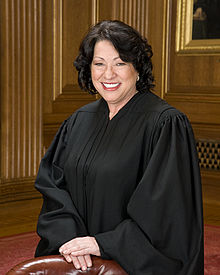
Sonia Sotomayor, Associate Justice of the Supreme Court
Strong non-Anglo in American Culture women aren't limited to fiction.

Why this is...?  It might be an attempt to dis-empower non-Anglo by using a 'weak' symbol. It might be a carry over from Orientalism, where viewers sexualize the exotic 'other'. It might be a way to soften the  integration of non-Anglo into American culture. Of course the male 'other' does appear at times, but largely as a Brown, the inferior, or as an Alien, the unintelligible/irrational threat. We'll just have to wait and see how this new archetype integrates into the larger mythology, and how it effects American's perceptions of non-Anglos. Who knows, maybe Puerto Rico will become a state sooner than we expected.

Brown

  • Chang Community (NBC, 2009) - Mostly just strange. If he was more powerful he'd be an Alien
  • Abed Community (NBC, 2009 ) - Again, really strange. No sexual motivations
  • Mr. Chow The Hangover (Warner Bros. Pictures, 2009) - Although he causes trouble, he isn't a real threat.
  • Tom Haverford Parks and Recreation (NBC, 2009) - He started out as just a Brown in a greencard marriage, and although he's developed into a more influential character, he's not really all that important.  
  • Borat Borat (Four by Two, 2006) - Sacha B. Cohen played on American's perceptions of non-Anglo to create a very convincing Brown character.


Alien

  • Bane The Dark Knight Rises (Warner Bros. Pictures, 2012) - subservant to Miranda
  • Red Skull Captain America: The First Avenger (Paramount Pictures, 2011) - He's Russian
  • Matthew Bascalli (the Art Teacher) Parenthood (NBC, 2010) - Sleeps with Grandma!
  • Gustavo/Gus (Pollos Hermanos owner) Breaking Bad (AMC, 2008) - Despite his controlled facade, Gus' actions are not the most predictable, nor are any of the other Latino characters'.


Ambigous/Transitional

  • Oscar The Office (NBC, 2005 ) - Gay, and not a power player BUT he is having relations with Angela's husband. 
  • Ann Perkins Parks and Recreation (NBC, 2009) - She's more of a Girl, but she is racially ambiguous, and has gained power through the series.
  • Most Dwayne 'The Rock' Johnson movies - With the exceptions of The Mummy Returns The Rock plays characters that aren't neccisarily Browns or Aliens, just traditionally Anglo archetypes. 
  • Jacob in Twilight series - He doesn't end up with the 'heroine', but he's not powerless either.
Has anyone seen Puss In Boots (Dreamworks, 2011)? I couldn't glean much from the trailer, but it seemed like Puss is a cowboy who may have a spunky latina cat friend to protect him. Then again, he is a cute little kitty- Brown?


 -----------------------
Addition: I've named a new archetype after writing this post. The Amazon: Non-anglo individuals (usually women) who do not pose any sort of threat and are socially, politically, or sexually superior to their peers.


Keep the discussion going in the comments below.

Sunday, September 23, 2012

You Can Make a Coin Toss seem like Armageddon

" Why did football surpass baseball? Because football is perfect for the TV screen, which is actually shaped like a football field; because football is at once the most intellectual and the most brutal game in the world, in which the coaches think while the players bleed; because we love to see people knocked silly. But also, perhaps even primarily, because football mints the kind of uniquely vivid images that the Sabols could spin, over and over, into a Kip­ling poem about war." - Rich Cohen


If you're not a football fan, you probably hang around some of the 64% of Americans who watch NFL or the 200+ million who watch NCAA Football. Now, if you've been around a TV with a NFL game on,  you've noticed all the teams commemorating Steve Sabol, who died this week. Sabol apparently, made football into what we know it as today. Before it was just another sport. Sabol groomed it into a "never ending drama" (Producer Ken Rogers). Drama is the correct term, but not in the daytime television sense. Football imitates the grand epics of Beowolf and the Illiad; the narrator lauds the heroes as they enter the battle field, describing their previous victories and losses, their backgrounds, and their special gifts. The bard sings an anthem of previous heroics as the new heroes mentally prepare. Then- kickoff. The narrator continues to objectively explain the battle, postulating strategies of the generals/coaches, giving insight to warrior/player's emotions, and questioning the gods/referee's influences on the outcome.

However as Rogers said earlier, the epic in football never ends. It continues with new heroes cycling in as the old ones fall out of favor. Both college and professional football continually engage their followers- there's never a point of 'well that's settled.' Rivalries between teams, coaches, players, owners, etc deepen the drama of the games, and therefore get viewers emotionally invested in their outcomes. It's a tit-for-tat system that will never end. Such sentiments are well illustrated in this recent George Tekai post:

It's a bit silly. But football is not just a silly thing that a lot of Americans like. How many times have we heard people roll their eyes and say 'its just a bunch of guys running into people.' I was once one of those people. Then I went to a SEC school and saw thousands of people participating in this bizarre ritual every weekend.  Not two or three thousand. More like eighty thousand. And that's just people in the stadium. People go the campus and just hang-out watching TV outside. Football is a silly thing that A LOT of Americans LOVE. 

I suspect this American romance follows the same mentality I explored in my Olympics post. This group is better than that group because these few individuals are athletically and mentally superior. Unlike the Olympics however, the team is more important than the individual. Yes, quarterbacks get all the advertisements, but I'm pretty sure fans of the Carolina Panthers, Denver Broncos, or Philadelphia Eagles would not say that the teams victories and losses' rest solely on the actions of Cam Newton, Peyton Manning, or Micahel Vicks. Fans understand that victory is a group effort, and fans believe they contribute to the victories as well- they are in fact a part of the team. 


Tailgating, going to the games, watching every games, and doing weird rituals aren't just conspicuous consumption. It's a way of identifying with other people and coming together to cheer on your side. And if a fan is one of those people who doesn't hang out with other people and instead watching football alone all weekend long- he's still part of the team. No lonliness. 

It's true! Kentucky Football fans exist!

Yes, football is a fabricated Reality of rivalry. Fans are Zombies (blindly buying into/following their team, despite the odds). Players are Astronauts (sacrificing their bodily health for the entertainment/success of their fans). All so that BEARBULL (advertising and NFL ownership) can influence more of individuals' lives. But, at least it's not the City. Football gives people something to believe in (maybe, just maybe we can win), and to look forward to (there's always next season). Zombie fans coming together in this way is not a bad thing. Its one of the few times Americans actually go hang-out with each other. 

Football isn't opera or an gallery opening or a natural history exhibit, but it's where many American's find relief from their true reality. It's not a television show or movie that points out how they're not a Cowboy or Astronaut. It's a community who accepts them as long as they like the team. 

-----------------------------

If you want to know more about how Football became America's sport, I recommend you read this article:


Monday, September 17, 2012

On Facebook You Are Who You Are


Previously I’ve established what movies, television, novels, and other fictional media convey to American audiences. But how do such messages affect our everyday lives? We don't see people running around in spandex, using their massive amounts of money to save a dying city (that's government work). Nor do we see women blatantly transform themselves into queen b's just to prove a point. We do see individuals striving to better humanity through academics, public service, or just being nice, and we do see people change aspects of their lives to better fit in or stand out- whichever is perceived as the way to success.
Cosplay: Not just for Adults

To understand how New American Mythology affects individuals we have to survey how people present themselves to world where they present themselves. Now, you may think, oh, obviously people walking around on the street. No. When was the last time you presented all of your true self to the street corner? You don't walk around (I assume) declaring Harry Potter as the best book series, congressmen talking about rape are idiots, Shock Top is your new favorite beer, or Fantasy Football is the same as Dungeons and Dragon

These proud, albeit random, disclosures of person's personalities occur on Facebook. We present ourselves to the (Facebook) world as we truly see ourselves- unapologeticly (unless you are) redefining ourselves with each status update, 'Like,' wall post, friend request, and defriending. Despite earlier thoughts, people don't use Facebook to create idealized personas. They may censor themselves or refrain from revealing too much, but they want to create an accurate depiction of their true personality.

As opposed to The Sims, Second-Life, chatrooms, and the other anonymous corners of the world wide web, Facebook users see the website as a representation of who they are. It's the one stop shop where others can browse your traits and decide if you are worth 'Friending' and to what extent. (Should we just be FB friends or should I try to hang out with you at school?) Additionally, because Americans tend to only 'friend' people they've met in real life, their actions are accountable. For example, someone posts that they really hate Twilight. Her friends may comment and say that she does like Twilight but really doesn't like Kristin Stewart because she's jealous. Or, people won't want to be the Twilight hater's friend, because she just lied about hating Twilight because it's 'cool'. Typical drama things.


My point is, Facebook is not an avatar creator. If you're familiar with the Jungian Archetypes, Facebook is where "From the Self -the totality of the psyche- the individualized ego consciousness emerges as the individual grows up" (Jung, Man and his Symbols). That is, individuals assemble their 'whole' selves on Facebook, marrying her Shadow, Anima/Animus, and Persona to create a Self that her ego accepts as true, even as each archetype changes. Adapting and abandoning likes, thoughts, and friends allows people to in some sense physically change their Self archetype and better understand who they are as a person. What's more, other people can understand who they are as a person.

Our understanding of a person goes beyond the text: Female Interested in Males and is Married, and instead reads 'Female Interested in [really nice] Males [who enjoy the Southern lifestyle] [but there are none around so she] is ["]Married["] [to Best Friend Katie]. People post their discoveries. They post their triumphs. They post their worries. They post how they fit in. They post how they stand out. They post things they think people want to know- about themselves, factoids, politics, rants, coupons, family. The combination of these posts describe the individual, not the single elements.


We still haven't gotten to the Mythology part of this. Where are the Astronauts, Cowboys, and Zombies on Facebook? They're there, just in a more subtle way. Facebook users display what interests them. The following are fictionalized portraits sewn together from my various friends. You have to keep in mind these are personas because I'm making them up. I've tried to make them as believable/accurate as possible.


The Cowboy:

Perhaps he likes hunting, the TV show Weeds, he quotes Boondock Saints, and the last book he read was The Watchmen.  Him and his bros pose for their pictures with calculated aloofness. He brags about all the girls he met at the club tonight. His photo albums are full of all the 'edgy' things he does- going to house parties, jumping off cliffs, graffiti he saw, and him chillaxin'. His comments skirt towards offensive, but it just shows how witty and free from conformity he is. The profile picture- him and his mutt chillin' with a beer in his dirty backyard.

The Astronaut:

On the Astronaut's profile page is all the beneficial and exciting things the Astronaut does. Her 'job' may be Volunteer at the food bank. She quotes Ghandi, Planet Earth is is favorite TV show, and he reads books like Lost Horizon. Her photos are of exotic places,  on a service trip, or running a marathon. Her Wall is covered with links to interesting facts, news clips, and exciting internet finds. She comments on controversial topics, but in an enlightened way that shows her intelligence. She and her pound puppy snuggle in his apartment to make a cute profile picture.


The Zombie:

Likes The Office, True Blood, Adventuretime, Glee, The Hangover II, Brave, 300, Gone With the Wind, 50 Shades of Grey, The Black Eyed Peas, The Beatles, the Clash, and a plethora of other media. Her photos are of the latest product she bought, dinner she ate, or hairstyle. She updates her page with comments on the latest episode of Jersey Shore or complaint going around town. Her photo shows the cute new sweater she purchased for her cute white dog.

Not Mine.

Again, these are not real profiles. In fact someone who likes to chillax with his buds may also like The Hangover II. Someone who runs marathons may also  like to show off her hairstyle. Someone who has a cute white dog might also go to house parties. How the person presents these aspects of their life determines which archetype they subscribe too. Focusing on products and material possessions is a trait of Zombies, whereas the Astronaut focuses on actions and effects, and the Cowboy on whatever is on the mind.

Another way of putting it:
Astronaut strives to better the 'collective consciousness' using their ego
Cowboy considers the 'collective consciousness' but follows their ego
Zombie mimics the 'collective consciousness' in their ego.

Also, I want to state that the Zombie profiles are not necessarily bad things, as it may come off as in the post. As mentioned earlier, Profiles reflect the individual's changing Self, and going through a phase where one relies on the Persona (of the collective consciousness) is common. If it wasn't, there would be far fewer psychologists, psychiatrists, counselors, and happy pills.