I want to apologize to all my avid readers for taking such a long hiatus. My excuses aren't very good, nor are they worth telling. Instead I want to take this apology* and explain to you why this blog exists. Most people, I believe, stumble onto this page through Google image searches (the top one being 'rosario dawson tits' at the moment). And those of you I actually know who click the link on my social networking sites, probably scroll through and think I'm a bit zany. This attitude and the general lack of enthusiasm for his blog discouraged me from opening up the Blogger browser tab for a few weeks. As we all know, feeling unsupported, being the only one interested in your work, and thinking your actions have no value doesn't make one want to continue to explore one's interests anymore.
Well fuck that. I ain't no pretend Astronaut, and I surely ain't no Girl (which Buzz is in this scene). No, I find my interpretations of my culture fascinating and insightful, and the zany portions of them are just to make it more interesting. New American Mythology may have started as a false exaggeration, but it does exist. It's real. As real as Christianity, Islam, and Buddhism!
NPR recently reported that young Americans don't self-identify as part of a particular organized religion, and that doesn't include people who say they are of a religion, but aren't actually 'devout'. Most of the people interviewed cited social issues as their main reason for not taking part in religion. My question in this discussion is, Where, then, do they get their social cues of what is acceptable and what isn't acceptable? What do we believe in? What motivates us? Why do we continue in this matter?
Our culture clearly influences our morals and therefore our actions, otherwise the Senate would be singing Don't Stop the Party and not We are Never Getting Back Together when a controversial bill came onto the floor. Instead of getting angry and frustrated (or after getting angry and frustrated) with all the bizarre things in this world, I take a look at what could cause it. Not just why is the Senate not doing its job, but also why am I so angry (or not angry) with them? I'm just trying to make sense of this zany world. If the only way I can do that is through a zany blog with a zany lexicon then so be it.
You see, I don't care about your well-being. This blog is for me and my well-being. I will be frustrated by people who don't give a damn about what their culture teaches them, which includes the 'I don't watch TV so pop culture isn't relevant to me' (my ass) people and the 'It's just Grey's Anatomy' (zealots) people. But hey, maybe one day I'll figure out why they do that. If you made it this far into the post I assume you have some mild interest in the topic, or in what I'm doing. Good for you. I'm glad to have you. Please have an opinion, and let me know. It means people are still alive out there.
I have drive. I have smarts. I have means. I have character.
I'll be chasing down my own Tom Chaney with or without others' help. And you, Mr. Cogburn, in your oh-so-wizened ways may join me. As to your question, What are you? A Cowboy.
What about you?
-----------------------
* This isn't actually an apology.
Sometime during the past few chaotic months, a DC Entertainment announced that they will release a Justice League movie in 2015. As nerds do in our nerd culture, there has been a lot of speculation about which DC Universe it will draw from, what/who will be the villian,who will play what characters, and so on. We can bet that Superman will be in the movie, and maybe the Green Latern.. blah blah blah. I'm not a comic-book nerd, and don't care about who's in the movie. Except, of course, Wonder Woman!!!
In addition to the movie, DC is also allowing the CW to make a TV show starring this powerful woman before she's a powerful woman ("looks at the teenage years of the heroine who will become Wonder Woman.") We can only pray that means Buffy the Vampire Slayer not Jess the New Girl. I say this because Wonder Woman cannot be a Girl. Doing so would diminish the most powerful, recognizable, and badass comic book heroine hero and reinforce the standard of 'women need men to do anything'. That also doesn't mean I want her to be stereotyped as a manipulative-icequeen-manlady-irratic-bitch. Treat her as you would treat any main character; as an complex individual that often has conflicting motivations, who must decide for herself what is right and what is wrong and then act on the decisions by her own will.
After establishing the personality of Wonder Woman the Amazon (as in the New American Mythology Archetype, because she actually is an Amazon from Themyscira) let's establish what she should look like. The comic industry has one of the worst records of objectifying women. Just go to http://thehawkeyeinitiative.com/ and you will instantly understand all the ridiculousness. Wonder Woman certainly cannot go that route, but she is a bombshell of womanly sexual power. After all, we don't watch all of Ryan Gosling's movies for the plot. The key to keeping Wonder Woman, or the portrayal of anyone, sexy not sleazy is to make sure you're not degrading the character in order to make them sexy. Meaning not only good personality and acting but also framing the shots so they make sense within the plot. And no slow-motion running scenes. And no waifs.
[I also believe 'they' should get rid of the traditional unitard and update Wonder Woman's costume to something more contemporary; Lynda Carter may have been able to fool people in the 70's with a quick costume change, but citizens of the 21st century are a bit more wary to a near-naked woman running around the city. I mean, Batman, Ironman, the X-Men, Joker, and Hawkeye got awesome new wardrobes.]
For some reason, comic-geeks are opposed to Wonder Woman getting new pants.
I disagree. From here.
The following are some of my choices for the next Wonder Woman, particularly for the Jutice League movie. I'm so excited/hopeful to see a strong woman superhero!
Alica Braga - Preadators, I am Legend
Screw canon, Diana (Wonder Woman) doesn't have to be paled skinned and blue-eyed. Make her a true NAM Amazon by casting a Brazilian (see, Amazon makes sense). Braga has the hair, faceshape, body, and ass-kicking skills of Wonder Woman.
She might be too skinny. However, she can wear a leotard. I think she may be good because of her role in Avatar as badass powerful alien Amazon woman. It wouldn't be too far of a stratch to swap the blue skin for red boots right?
Rosario Dawson - Sin City, Seven Pounds
Dawson would be another changeto canon. I believe she would be the best of the actresses I've chosen at playing up the hard/soft nature of Wonder Woman.
Mila Kunis - Black Swan, The Book of Eli
A more contemporary twist on the traditional Wonder Woman. Quirky and cool, spunky and sexy. I think this would be like the Anne Hatheway>Catwoman choice: odd, but it could work! Not so sure how well she can fight though.
Alison Brie - Mad Men, Community
Brie is my traditional suggestion. Sure, she plays uptight characters, but I see the potential. Slap a crown on her head, throw on some boots, and give her a lasso! WONDERWOMAN!
For the TV Show: Adelaide Kane (she was in Power Rangers?) Alexandra Daddario (again, very traditional looking WW. She was Athena's daughter in Percy Jackson and the Lightening Theif, basically an amazon.) I bet $10 she gets the TV Show.
What do you all think? Should sexism be preserved for the sake of tradition? Have a better choice for Wonder Woman? Will Lynda Carter always reign supreme? Leave comments below.
Stephen Colbert had actor Tom Hanks on his show the other day. The skit features trick-or-treaters showing off the diversity of heroic characters the actor has portrayed (while plugging Cloud Atlas where Hanks plays multiple characters). It was a fantastic example of New American Mythology on several levels. First, both the real person and the characters have become icons of American culture. Everyone recognizes the names Tom Hanks, Woody, and Forrest Gump and views them as separate icons. This is different than Will Ferrell characters for example. People recognize Ferrell as an iconic actor, but he is not separate from his characters- instead its Ferrell as racecar driver, Ferrell as man-child, Ferrell as a news anchor. (There are exceptions of course, such as Buddy the Elf.) For Hanks, both being an icon and portraying/creating icons means he has a strong presence in New American Mythology in both the past an present.
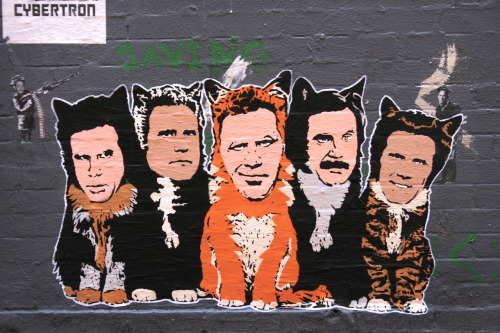
An artwork by street artist Tom Hanksy
(as in Tom Hanks + Banksy)
Because of his pantheon of characters, Hanks' mythic presence reaches all types of people regardless of the genre preference, age, gender, and race. He appeals to everyone, allowing him to explore, perpetuate, or change New American Mythology with broader strokes than a single movie, show, or character could do on its own. People pay attention to what he does.
Which leads to the second point: Hank has the ability to influence New American Mythology's direction in the future. Hank has taken advantage of this through his recent roles which tend to convey a wholesome, positive message or somehow educate the audience. That is not to say his character in Philadelphia(Tristar Pictures, 1993) for example didn't do that. Rather, Hanks now seems to consciously create/seek roles that enlightens audience with morals or history. Specifically: Charlie Wilson's War (Universal, 2007), The Pacific* (Dreamworks SKG, HBO Films, 2010) as narrator and producer, Extremely Loud Incredibly Close* (Paramount Pictures, 2011), and Cloud Atlas* (Cloud Atlas Production Company, 2012). Of course, to fund such projects (and keep his status as mythic icons) Hanks still acts in movies like The Polar Express* (Castle Rock Entertainment, 2004) and Angels and Demons* (Columbia Pictures, 2009).
I found Polar Express to be on the edge of the uncanny valley.
Not that either category is more influential or better than the other. Take The Da Vinci Code (Columbia Pictures, 2006); A lone man (Robert Langdon) must solve a mystery to prove himself innocent, and in that process discovers the Vatican's secret. *Spoiler* The secret is that Jesus and Mary Magdalene had a daughter who would have been the 'true heir' of Christianity. Of course the patriarchal system of the Vatican found this terrible and stopped it. The movie critiques Catholicism, patriarchy, and authority as a whole while questioning the purpose of iconography that perpetuates certain ideals (i.e.Why do we revere da Vinci's deteriorating painting, Last Supper?). Larry Crowne (Universal Pictures, 2011) on the other hand is a more encouraging movie, where instead of falling into depression after losing everything, the main character seizes the day and goes back to college. A very feel good, happy movie that advises people to turn negatives into positives, but it's really not a reality shattering message.
So what does this all really mean? Tom Hanks' work reveals New American Mythology as spanning the past, present, and future on multiple fronts, influencing how Americans see and react to the world around them. The following character analysis shows that Hanks chooses roles that emphasize that all individuals can succeed, no matter what skills they have.
An Astronaut, Cowboy, and Zombie:
Forrest Gump (Paramount Pictures, 1994) - Forrest is a Zombie in the best way possible. He lacks rationality, is unthinking, acts out of compulsion, and has no real need for purpose in life. All these things of course make him a great football player, soldier, ping-pong player, and runner. His selfless nature often puts him in dangerous and inadvisable situations while his impassive personality allows him to not be governed by traditional wants and desires (i.e. money, fame, sexual conquest, etc). He is a Zombie. No arguing. Apollo 13 (Universal Pictures, 1995) - Jim Lovell is a real figure in American History. Tom Hanks/This movie turned him into a real figure in American Mythology. Lovell is the most Astronaut of astronauts to ever grace the silver screen. He is rational, empathetic, and calm throughout the movie, despite his dangerous situation. And, of course, he placed himself in a situation (going to the moon) that he knew could go very wrong, just to better American's knowlegdge/image.
Toy Story (Pixar Animation Studios, 1995) - Woody is a not a Cowboy, but an Astronaut. He is rational, looks out for others, and willing to risk his happiness for others. The closest Woody comes to becoming a Cowboy is worrying about his position as leader of the toys when Buzz comes around. So when the doll says "Reach for the Sky!," he's not enforcing western law, but telling you to set your aims higher.
[Tom Hanks doesn't really play Cowboy characters, with perhaps the exceptions of Jimmy Dugan in A League of Their Own (Columbia Pictures Corporation, 1992), Joe Fox in You've Got Mail (Warner Bros., 1998), and Michael Sullivan in Road to Perdition* (Dreamworks SKG, 2002). This trend continues in the 21st century, unless you want to count...]
Cast Away (Twentieth Century Fox Film Corp, 2000) - Chuck Noland whose journey transforms him from a Zombie to a Cowboy and/or Astronaut. He begins as a Zombie- focusing on his job to get money, despairing at his situation, and hoping someone else saves him. Eventually he learns that he must fend for himself, fight to live, like a proper Cowboy in a purgatory West. However, one could also argue that he is an Astronaut, living in isolation and relying only on himself to survive trying to find the truth of himself in purgatory West. Even the movie's end could be argued either way- is he a Cowboy living on his instincts, going wherever the wind blows him, or is he an Astronaut journeying into the great unknown, searching for the mysterious Truth.
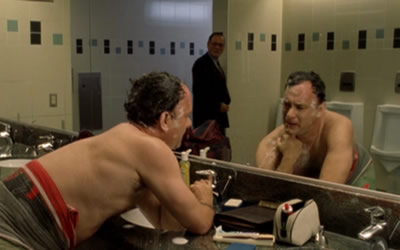
Shenanigans in The Terminal
The Terminal (Dreamworks SKG, 2004) - Viktor Navorski is a Brown. I wanted to include this movie, despite its relatively bad reviews to show that Hanks does not always stick to the main archetypes. Navorski not an isolated Astronaut who uses rationality to fight his situation. He is not a Cowboy who would have just busted out of there. He might be a bit of Zombie who only follows the rules, but he is a bit too compassionate, helpful, and resourceful to really fit in that archetype. Navorski, an Eastern European, has no power (politically, sexually, and seemingly socially). However, he still turns his situation into a positive experience helping his fellow man [maybe he is an Astronaut].
I could do this all day with Hank's films. I could go in depth to every one of them (especially the Toy Story franchise), but there are so many it might get boring for you. However, feel free to leave your own observations, questions, and comments below.
With that I'll leave you with an Astronaut Tom Hanks quote:
"I love what I do for a living, it's the greatest job in the world, but you have to survive an awful lot of attention that you don't truly deserve and you have to live up to your professional responsibilities and I'm always trying to balance that with what is really important."
Walking Dead (AMC, 2010) started up tonight, signaling the start of Zombie season. I don't mean the time that the television show airs- I mean the time of year that consumerism takes over the minds and motivations of Americans.
PBS video to celebrate the Season
Like pre-industrial cultures, autumn is a time for celebration, preparation, and consumption. Traditionally, the event is to prepare for the hard-long winter and/or to harvest the crops. Luckily, the majority of Americans American's do not have to worry so much about food security and instead just get to celebrate abundance. That's not to say that other times of year are void of conspicuous consumption or unnecessary excess. After all, do you really need 2 packs of hotdogs, a pound of burgers, and ribs at the family Fourth of July barbecue? Zombie season is just where it's a little more obvious and often and without the connotations of rebirth (Easter/Spring, Forth of July/Summer). And it comes with the premiere with Walking Dead.
Autumn settles in during October; the cold weather sets in and the leaves begin to fall. Associations with death are well known. However, American's don't worship Osiris or Persephone. They worship the Zombie archetype (God of Consumerism). During Halloween, the Zombie manifests itself by encouraging people to dress up as their favorite characters and buy copious amounts of overpriced candy. Unlike Dia de los Muertos, Halloween does not hold any sort of religious connotations nor gathering of family (unless you want to count children going to trick or treating as gathering as family. I don't.) The holiday celebrates popular culture; all ages can become Astronauts, Cowboys, Zombies, Blacks, Browns, and Girls without looking like a total nerd (unless that's what you're going for).
That's just the beginning however. Thanksgiving comes up about four weeks later. Again, the holiday does not have religious connotations, but it does focus on family, patriotism, and tradition. The literal consumption of food and gathering of family hearkens to the Harvest Festivals of old. Even though Thanksgiving retains the integrity of such festivals and isn't as Zombie-ridden as Halloween (or the next holiday), it still contains giant floating pop culture icons and football, which I've already described as Zombie driven.
Then, the big one. Christmas begins before Thanksgiving. We've all heard the complaints/celebrations on the advanced arrival of the 'holidays'- and that's just the decorations and music. On Black Friday (an event that has it's own name) people bull rush stores to collect bits and bobs to give to children, adults, dogs, cats, and everything in between. All sorts of confectioneries and limited edition drinks pop into existence as temptations. Christmas morning (for most people) creates a mess of wrapping paper and boxes. Food usually makes an appearance in amounts comparable to Thanksgiving, but with more sweets. Christmas does have religious aspects connected to it, but these are overshadowed by the Zombie celebrations.
It doesn't end there however, New Years brings similar Zombie consumption, except with friends rather than family. When else do over 3.5 million viewers tune in late at night to watch a bunch of commercials listen to mediocre music, and watch a ball drop? Answer: The Superbowl.
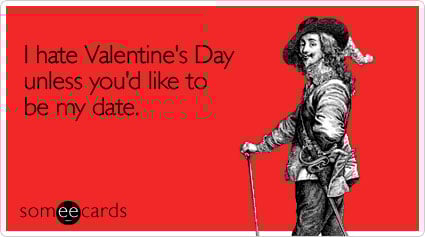
Finally the last Zombie holiday, Valentine's Day. It straddles Winter and Spring- both pressuring people to, again, eat more candy, and force themselves into uncomfortable situations for the sake of social pressures. Again, the holiday has no religious connotations.
The most ironic holiday
That's five months and six holidays, only one that still follows the religious practices that initiated it, (you could, arguably, call the Superbowl a religious holiday) while Thanksgiving remains closest to its original intent (to give thanks to being a United America). The Zombie season is a celebration of America to it's maximum. Individuals may not think about the holidays, but they do find the time to honor their culture. That's why they are the most celebrated holidays.
I must mention that BEARBULL is so thoroughly ingrained in all these holidays, it's all about consumption and getting the money flowing. The irony of The Walking Dead is that while a group of individuals struggling to survive the zombiepocalypse with next to nothing, Americans eat up all the drama and violence.
I want to discuss the Brown, because I believe this archetype is morphing. And in an odd way. Previously I believed the Brown were "non-Anglo foreigners who do not pose any sort of threat. Socially, politically, and sexually inferior to their black or white counterparts, browns often appear as comic-relief" namely Hispanics, but could include any non-Anglo character.
For example, the very entertaining movie Moulin Rouge! (Twentieth Century Fox Film Corp, 2001)* has five prominent male characters: Christian, The Duke, Harold Zidler, Toulouse-Lautrec, and The Unconscious Argentinean. (Okay the Argentinean isn't very prominent, but he sings a song). You'll note that the first three actors listed are of Anglo descent (Scottish, Australian, and English) while the last two are not (Colombian and Polish). Yes, the characters of Zidler, Toulouse, and possibly the Duke are French but what counts are visual cues and accents. We perceive the main influential/manipulating characters (Christian, the Duke, Zidler) as Anglo, while the side characters (who still play a role, just not active ones) as non-Anglo. Toulouse and the Argentinian never threaten Christian's chances with Satine, and only act as advisers/friends.
[*Moulin Rouge! is listed as both a American and Australian film on imdb.com; I'll let you decide if this is allowed in the New American Mythology cannon.]
Besides obvious 'White Anglo-Saxon Protestant Male' dominance that has pervaded American culture since its founding (by WASPM), I believe that kind of Brown existed for several reasons. First, the 20th Century was dominated not just by America, but the United Kingdom, Germany, and the USSR, and after World War II, to just America and USSR. Which means those 'other' countries (i.e. Mexico, China, Iraq, India, etc) aren't of too much concern. Eastern Europeans and other communist countries (non-Anglo countries), unfortunately, were the enemy and therefore characterized as impotent savages.
He looks just like a Wildman
And by Wildman I mean this guy
Next, the United States won the Cold War, and not just against the USSR. Communism proved to be inferior to capitalism in Latin-America,Asia, Eastern Europe, and vicariously parts of the Middle East. The communist aligned nations were riddled with general instability and lack of infrastructure that stalled economic growth and political development.
Finally, the 9/11 attacks brought a crises of faith for American citizens. They questioned their supremacy, their dominance, and thought that maybe they weren't as potent as they believed. What's more, China and India's econmies and populations burgeoned, taking with it American jobs and investments. In the U.S., Latin-Americans and other other non-Anglo-Americans began to develop stronger presence, voicing concerns of discrimination in politics, the media, and the larger communities. In the first decade of the twenty-first century Americans sensed the world shifting away from WASP dominated culture. However, the media decided to reassure the public that the 'foreign' invasion was benign with characters like the Argentinean or Toulouse-Lautrec, Fez in That 70's Show, or Oscar in The Office.
Cece in New Girl (Fox, 2011)
The powerful, confidant, sexy best friend of Jess.
However, I believe this is no longer the case. Foreigners have become stronger, smarter, and sexier. Maybe it just took a decade for the media to catch up to people's beliefs. Or maybe the recession has disillusioned those who had clung to the 20th Century. The 'Other' are no longer just the backward folk who live on the fringes of society. They are, in fact, real people, doing real work, with real lives, real culture, and real opinions...
...which may differ from the 'majority's' in good and bad ways. Now we see non-Anglo transitioning from the background and emerging as a part of American society. American culture processes this change in various ways. The conflicts between the past perspectives and present projections surface in quite interesting ways.
Perhaps the more familiar example of such conflicting ideas is in The Big Bang Theory (CBS, 2007 - ) with the Koothrappali siblings. Raj exhibits the old perceptions: he's inept with women, is a sidekick (to the sidekick), and has sexually ambiguous moments. Overall, rather submissive. Priya on the other-hand gets pick of the guys, is a self-possessed woman (separate from both the girls and the boys), and does not hide her sexuality. Overall, rather normal (compared to depictions of WASPM). And there's the odd part- the rise of the 'other' in America Culture comes in the form of a woman (distinctly not a Girl). Other examples include, Gloria from Modern Family (ABC, 2009), Dr. Cristina Yang from Grey's Anatomy (ABC, 2005), Miranda from The Dark Knight Rises (Warner Bros. Productions, 2012), and Neytiri from Avatar (Twentieth Century Fox Film Corporations, 2009).
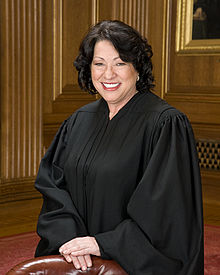
Sonia Sotomayor, Associate Justice of the Supreme Court
Strong non-Anglo in American Culture women aren't limited to fiction.
Why this is...? It might be an attempt to dis-empower non-Anglo by using a 'weak' symbol. It might be a carry over from Orientalism, where viewers sexualize the exotic 'other'. It might be a way to soften the integration of non-Anglo into American culture. Of course the male 'other' does appear at times, but largely as a Brown, the inferior, or as an Alien, the unintelligible/irrational threat. We'll just have to wait and see how this new archetype integrates into the larger mythology, and how it effects American's perceptions of non-Anglos. Who knows, maybe Puerto Rico will become a state sooner than we expected.
Brown
Chang Community (NBC, 2009) - Mostly just strange. If he was more powerful he'd be an Alien
Abed Community (NBC, 2009 ) - Again, really strange. No sexual motivations
Mr. Chow The Hangover (Warner Bros. Pictures, 2009) - Although he causes trouble, he isn't a real threat.
Tom Haverford Parks and Recreation (NBC, 2009) - He started out as just a Brown in a greencard marriage, and although he's developed into a more influential character, he's not really all that important.
Borat Borat (Four by Two, 2006) - Sacha B. Cohen played on American's perceptions of non-Anglo to create a very convincing Brown character.
Alien
Bane The Dark Knight Rises (Warner Bros. Pictures, 2012) - subservant to Miranda
Red Skull Captain America: The First Avenger (Paramount Pictures, 2011) - He's Russian
Matthew Bascalli (the Art Teacher) Parenthood (NBC, 2010) - Sleeps with Grandma!
Gustavo/Gus (Pollos Hermanos owner) Breaking Bad (AMC, 2008) - Despite his controlled facade, Gus' actions are not the most predictable, nor are any of the other Latino characters'.
Ambigous/Transitional
Oscar The Office (NBC, 2005 ) - Gay, and not a power player BUT he is having relations with Angela's husband.
Ann Perkins Parks and Recreation (NBC, 2009) - She's more of a Girl, but she is racially ambiguous, and has gained power through the series.
Most Dwayne 'The Rock' Johnson movies - With the exceptions of The Mummy Returns The Rock plays characters that aren't neccisarily Browns or Aliens, just traditionally Anglo archetypes.
Jacob in Twilight series - He doesn't end up with the 'heroine', but he's not powerless either.
Has anyone seen Puss In Boots (Dreamworks, 2011)? I couldn't glean much from the trailer, but it seemed like Puss is a cowboy who may have a spunky latina cat friend to protect him. Then again, he is a cute little kitty- Brown?
-----------------------
Addition: I've named a new archetype after writing this post. The Amazon: Non-anglo individuals (usually women) who do not pose any sort of threat and are socially, politically, or sexually superior to their peers.